Polish Post Office No.1 in the Free City of Gdansk
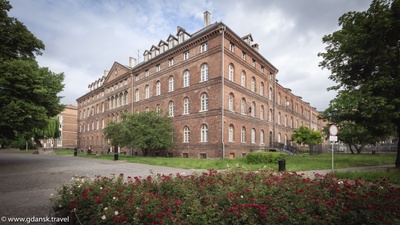
In a former 19th-century hospital building, a Polish postal facility was established in 1925 in the Free City of Gdańsk. By 1930, it had become the main Polish post office in Gdańsk, with a telephone exchange providing direct connections to Poland. In 1939, about 100 people worked there. On the morning of September 1, 1939, at 4:45 a.m., the facility was attacked by SS and Gdańsk police units. The defenders, armed only with pistols, faced three armored cars and two cannons. The German plan involved breaking through the wall of a neighboring building, engaging the defenders with a frontal assault, and then storming inside, but the attack was repelled. The plan of the Polish General Staff anticipated six hours of defense until the arrival of the Pomorze Army, but the postal workers did not receive the information about the withdrawal of the Intervention Corps or the cancellation of the defense order.
During the second assault, the defense commander, Konrad Guderski, died from the explosion of his own grenade, but the attack failed again. The third attack, launched around 11 a.m., was supported by two 75 mm cannons, but this assault also failed. Around 3 p.m., the German command ordered a pause in the assaults and gave the postal workers two hours to surrender, while simultaneously bringing in a 105 mm howitzer and preparing an underground mine with a 600-kilogram explosive charge. After the ultimatum expired, at 5 p.m., the charge was detonated, causing part of the front wall to collapse. The Germans, supported by three cannons, stormed into the building, forcing the postal workers' defense to retreat to the basement. Around 6 p.m., the Germans used motor pumps to pump in gasoline, which they then ignited with flamethrowers. At around 7 p.m., after 14 hours of heroic defense, the postal workers surrendered. Director Dr. Jan Michoń, who emerged from the burning building carrying a white flag, was shot, as was the postmaster, Józef Wąsik, who followed him. Six people managed to escape from the post office building. Two of them, Franciszek Mionskowski and the wounded Alfons Flisykowski, were arrested on September 2 and imprisoned with the other defenders. Four others—Andrzej Górski, Franciszek Mielewczyk, Władysław Milewczyk, and Augustyn Młyński—managed to escape and survive the war. The remaining 28 people were detained at the Police Presidium, and the wounded and burned were transported to the city hospital.
The group imprisoned at the Police Presidium was transferred after a few days to Victoriaschule, a prison where Poles from Gdańsk were tortured in the first days of the war. This group was tried in the first trial of the postal workers on September 8, 1939. The fate of the defenders varied. The dead were buried at the cemetery in Zaspa, now the Cemetery of Victims of Nazism on Bolesław Chrobry Street. Those who survived were arrested and later sentenced to death. Postal workers who did not participate in the defense were sent to concentration camps. In 1995, the sentence condemning the postal workers was annulled, and they were acquitted. The verdict cited violations of legal procedures and breaches of the provisions of the Fourth Hague Convention of 1907.