A History of the Oliwa Mill: From Fulling Mill to the Present Day
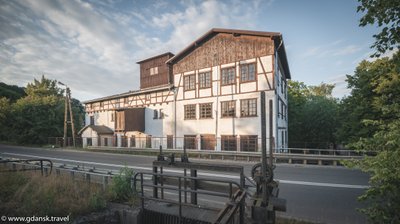
The first mention of a mill in Oliwa dates back to 1594, when it operated as a fulling mill, used for the processing of cloth. In 1613, it was acquired by the Cistercian convent of Oliwa and rebuilt as a grain mill, remaining in the possession of the order until 1831. A significant renovation took place in 1874, when the current mill building was constructed, although both structures underwent numerous modifications. Further major modernizations were carried out between 1881 and 1893, in the 1920s, and in the years 1935-1940 when the mill was electrified.
At the turn of the 19th and 20th centuries, the mill passed through the hands of various owners. Between 1914 and 1926, it belonged to Johannes Werner, followed by Sophia Werner (1927-1928) and Erben Wernersche (1929). From 1931 to 1942, the mill was managed by Arnold Kirsten, with the exception of 1936-1937, when the owner was the company Dahlmann J. off H.-G., which had been operating in the mill since 1916.
After World War II, the mill was taken over by the state. In 1946, it operated as the State Water and Electric Mill, and in 1956 it belonged to the Bydgoszcz Flour Mills. In the 1980s, it underwent a thorough renovation and in 1992 was purchased from the Provincial Grain and Flour Industry Enterprise in Gdańsk and passed into private hands.
Today, the mill in Oliwa, with its rich history dating back to the 16th century, stands as a testament to the region's centuries-old industrial heritage.