The Great Armory in Gdańsk – A Monumental Testament to Power and Craftsmanship
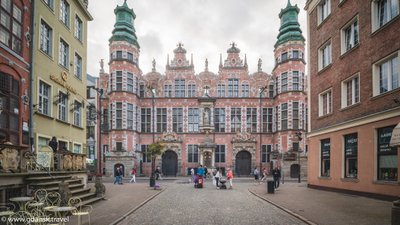
Erected between 1600 and 1605, the Great Armory in Gdańsk, situated along the western stretch of the medieval walls of the Main Town, stands as one of the most outstanding examples of Dutch Mannerism and one of the largest arsenals of its kind in Europe. This grand structure, designed by city architect Anton van Obbergen and Hans Vredeman de Vries, was meant to showcase Gdańsk’s might, while the sculptural details by Willem van der Meer the Younger and Abraham van den Blocke bestowed it with exceptional prestige. The facade, made of red brick with light sandstone and adorned with gilded ornaments, features depictions of exploding grenades and figures of knights—symbols of the city’s readiness for defense. Octagonal towers with helms crowned by spiral staircases, the statue of Minerva—the Roman goddess of wisdom—and two monumental entrance portals with coats of arms supported by lions create an impressive facade. Next to the portals lie 19th-century mortars from Gradowa Mountain, commemorating the building’s historical role. The armory’s interior, covering nearly 2000 m² and supported by 15 granite columns, once served as a storehouse for weapons and ammunition. Arms were displayed on movable mannequins, which became a major attraction for visitors. In March 1919, a restaurant, "Zeughaus-Automat" GmbH, with vending machines for ready-made meals, opened on the ground floor. After being taken over by the city authorities, a shopping arcade called Zeughauspassage opened here in 1923, featuring Rosenthal porcelain showrooms, amber shops, a bookstore, a perfumery, and a philatelic shop. By 1939, the arcade was a major commercial hub, housing eleven stores. The Great Armory underwent numerous renovations, especially in 1699, 1768, 1887, and 1911. Following war damage in 1945, when its interior was almost entirely burned out and the towers and gables were destroyed, the building was meticulously rebuilt. Since 1954, it has housed the Academy of Fine Arts, and its restored interiors now serve educational and artistic purposes, symbolizing not only the city’s military past but also its rich cultural heritage.